

Crane control remotes are wireless devices that enable operators to safely manage overhead cranes like EOT models from a distance. They typically consist of a handheld transmitter and a crane-mounted receiver that communicate via encrypted radio signals for precise control of hoisting, traversing, and other movements.
This technology enhances safety by keeping operators away from hazards, improves visibility, and boosts efficiency in industrial settings. Key features include emergency stops, frequency hopping to avoid interference, and ranges up to 200 meters.
A crane control remote is a wireless device that lets operators manage crane operations safely from a distance. It enhances precision and visibility compared to wired pendant controls.
Download Brochure – Access the latest product brochure directly from SRP’s site for full details on wireless remotes.
Definition
A crane control remote, also called a radio remote control, is a handheld wireless transmitter that sends commands to a crane’s receiver unit via radio frequency (RF) signals. This setup allows operators to control functions like lifting, lowering, and maneuvering loads without being near the hazardous load area.
The device improves safety in industrial settings such as construction, manufacturing, and warehouses by keeping personnel out of harm’s way.
How It Works
Operators input commands using buttons or joysticks on the transmitter, which encodes and broadcasts encrypted RF signals multiple times per second. The crane-mounted receiver decodes these signals and activates the corresponding motors for actions like hoisting or trolley movement.
This continuous signal exchange ensures real-time responsiveness, with security features like unique ID codes preventing interference from other devices.
Basic Components
- Transmitter: Handheld unit with joysticks/buttons, powered by AA batteries (lasting up to 2 months), and ergonomic for one-handed use.
- Receiver: Crane-mounted box that receives signals, decodes them, and connects to control circuits via pre-wired cables for easy integration.
- Additional Features: Emergency stop button, antennas for signal transmission, and protective enclosures rated for harsh environments (e.g., IP65 waterproofing).
Types
- Robustronic Series Crane Control Remote
The SRP Robustronic Series offers reliable wireless radio remote controls designed specifically for crane operations, enhancing safety and efficiency in industrial settings. These systems are built for material handling tasks like EOT cranes, providing robust performance in harsh environments.
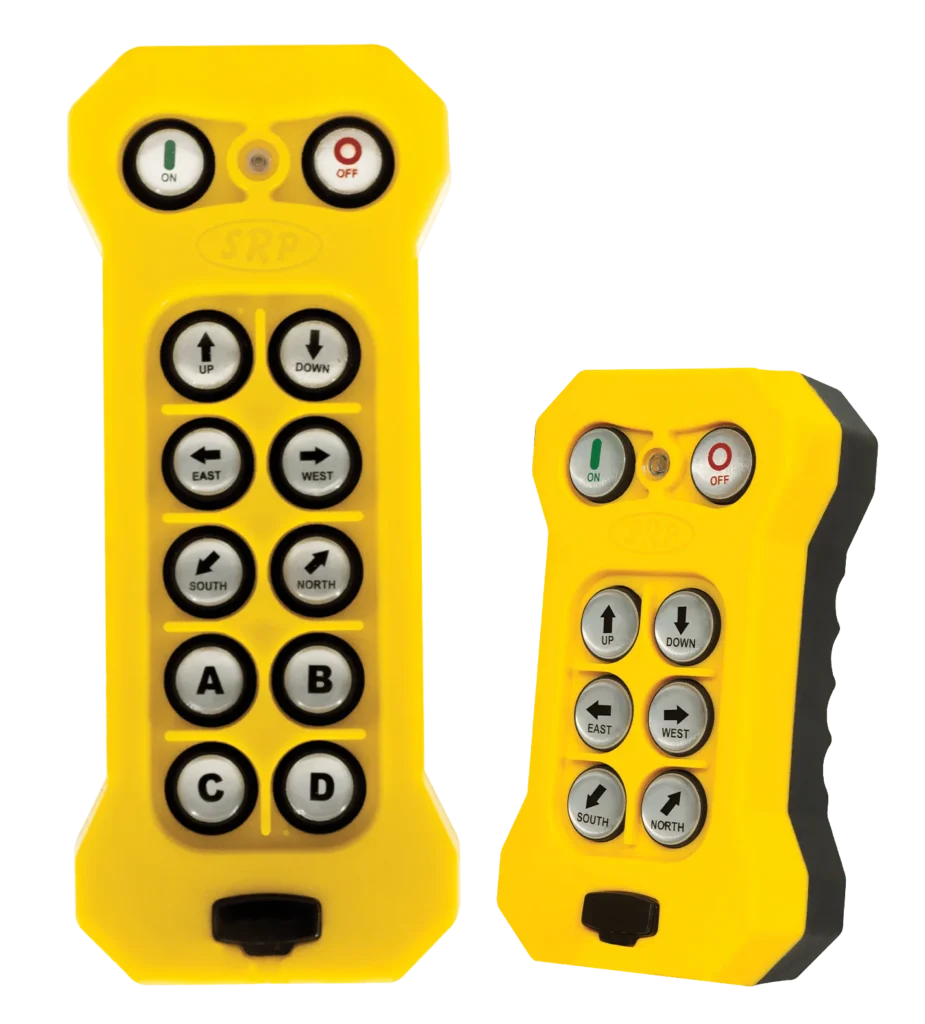
Features:
- 1 year Mfg. Warranty
- 100% in house production
- Easily Repairable anytime, thanks to our in house PCB Manufacturing
- Range of up to150 meters
- IP65 Water resistance upto 50 meters
- Preplanned pick up and drop (pre-planned fix position of crane at various place)
- You can also operate 2 or more crane from remote (transmitter)
Variations:
- RT6S – 6+2 Single Speed
- RT6D – 6+2 Double Speed
- RT10S – 10+2 Single Speed
- RT10D – 10+2 Double Speed
2. Newedge Series Crane Control Remote
SRP’s Newedge Series Crane Control Remote offers advanced wireless control for cranes, prioritizing safety and efficiency in industrial settings. This system from SRP Crane Controls (India) Pvt Ltd uses cutting-edge technology for reliable operation across EOT cranes, hoists, and material handling equipment.
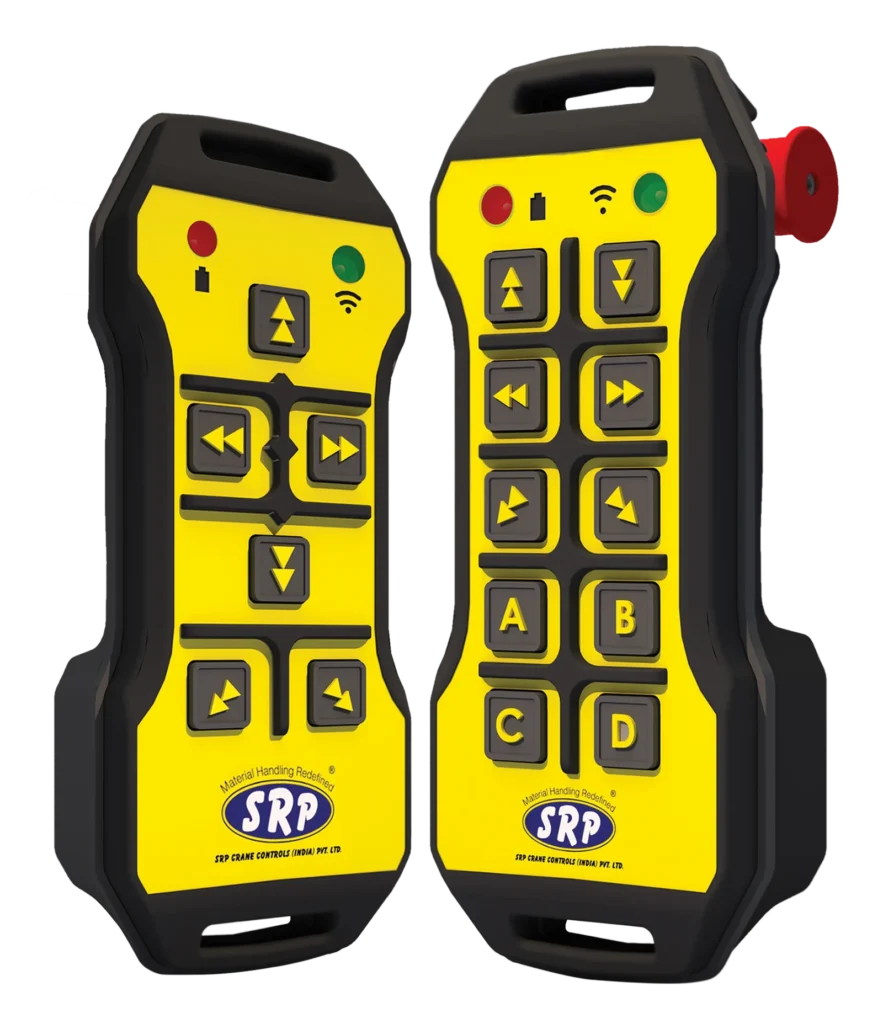
Features:
- Support for various modulation schemes (2-FSK, GFSK, MSK)
- Low power consumption (14 mA RX, 7-22 mA TX)
- Data rate up to 600 kbps
- AES-128 encryption for Secure data transmission
- Programmable data rate and frequency and Wake-on-radio (WOR) mode
Variations:
- NE6S – 6+2 Single Speed
- NE6D – 6+2 Double Speed
- NE10S – 10+2 Single Speed
- NE10D – 10+2 Double Speed
How Crane Remote Control Systems Work
Crane remote control systems enable precise, wireless operation of overhead and industrial cranes, enhancing safety and efficiency over traditional wired controls.
Signal Transmission (Radio Frequency)
Crane remote controls primarily use radio frequency (RF) signals for reliable wireless communication between the operator’s handheld transmitter and the crane’s receiver. The transmitter encodes commands—like hoist up, trolley left, or bridge forward—into RF signals, often employing frequency-hopping spread spectrum (FHSS) to avoid interference in busy industrial environments. These signals travel securely over licensed or license-free bands, ensuring minimal disruptions even at distances up to hundreds of meters.
This orange handheld transmitter exemplifies a typical RF device, featuring joysticks, buttons for functions like UP and LEFT, and protective elements such as IP65 rating and a fall sensor.
Receiver Mechanism
Mounted on the crane, the receiver unit captures RF signals via its antenna, decodes the encrypted data, and translates it into electrical commands for the crane’s motors and drives. It includes safeguards like signal verification to prevent erroneous actions from interference or lost packets. The receiver integrates directly with the crane’s power and control circuits, enabling smooth movements for lifting, traveling, and traversing.
Control Panel Integration
The control panel, part of the handheld transmitter, features ergonomic joysticks, push buttons, and displays for intuitive operation, allowing one-handed use by ground-level operators. Commands from the panel modulate onto the RF carrier wave, with modern panels offering customizable functions, dead-man switches, and feedback screens for status like battery life or load weight. This setup replaces bulky wired pendants, integrating seamlessly with the crane’s PLC or relay-based systems for precise motor control.
Safety Feedback Loop
Safety feedback loops provide real-time data from the crane back to the operator, such as load limits, torque, or collision warnings, displayed on the transmitter’s screen. Sensors on the crane monitor parameters continuously, and if thresholds are neared—like overload or anti-two-block conditions—the system can auto-intervene by slowing or stopping movements. This closed-loop design, often certified to SIL3/PLe standards, uses encrypted bidirectional RF to confirm command execution and alert on faults, drastically reducing accident risks.
Key Components of Crane Remote System
Crane control remotes provide wireless operation for overhead, gantry, and other industrial cranes, enhancing safety and flexibility by allowing operators to manage loads from a distance. Their key components work together to transmit and execute commands reliably in harsh environments.
Transmitter
The transmitter is a handheld device, often ergonomic with push buttons or joysticks, that sends encrypted radio signals to control crane movements like hoisting, traversing, and rotating. Operators input commands using these controls, and the unit typically runs on batteries like AA cells for extended use up to months.
It ensures one-handed operation for ground-based control, protecting signals from interference.
Receiver
Mounted on the crane, the receiver decodes incoming signals from the transmitter and activates motors or relays for precise actions. It connects directly to the crane’s electrical system via pre-wired cables, handling vibrations and tough conditions.
This unit communicates multiple times per second for real-time responsiveness.
Control Buttons/Joystick
These input interfaces on the transmitter include labeled buttons (e.g., UP, DOWN, LEFT, FWD) or multi-axis joysticks for intuitive crane functions. Joysticks enable proportional control for smooth speed variations, while buttons suit simpler on/off tasks.
They prioritize operator comfort to reduce fatigue during long shifts.
Antenna
The antenna on both transmitter and receiver facilitates reliable radio frequency communication over distances, often with scanners for multiple frequencies to avoid interference. It ensures signals reach through obstacles in industrial settings.
Power Supply
A robust battery or external supply powers the transmitter, with receivers often drawing from the crane’s main power. Systems include safety features like low-battery indicators to prevent operational failures.
Download Brochure – Access the latest product brochure directly from SRP’s site for full details on wireless remotes.
Features of Modern Crane Remote Controls
Modern crane control remotes have revolutionized crane operations in construction, manufacturing, and warehousing by prioritizing safety, precision, and reliability. These wireless devices allow operators to control heavy-duty cranes from a safe distance, reducing risks and boosting efficiency. Key features like long-range operation, emergency stop, multi-speed control, frequency stability, and dust & waterproof design make them indispensable for demanding industrial environments.
Long-Range Operation
Advanced crane remote controls now support transmission ranges exceeding 1,000 meters in open areas, thanks to high-power antennas and robust signal protocols. This enables operators to manage overhead cranes, gantry cranes, or mobile cranes from afar, minimizing exposure to hazards like falling loads or pinch points. For instance, in large shipyards, long-range capability ensures seamless control without line-of-sight limitations, improving productivity by up to 30%.
Emergency Stop Functionality
Safety is non-negotiable, and every modern crane control remote includes a prominent emergency stop (E-stop) button. This instantly halts all crane movements—hoisting, trolley travel, and rotation—via a dedicated, fail-safe radio channel. Independent of the main control signal, it complies with standards like ISO 13849 for performance levels, preventing accidents in high-risk scenarios like load swings or mechanical failures.
Multi-Speed Control
Precision demands versatility, so crane remote controls feature multi-speed selectors for hoist, travel, and bridge functions. Operators can switch between low-speed finesse for delicate positioning (e.g., 0-20% speed) and high-speed modes for rapid traversal (up to 100%), often with proportional joysticks. This reduces load sway, enhances accuracy in tight spaces, and cuts cycle times—ideal for assembly lines or steel mills.
Frequency Stability
Interference-free operation is critical in crowded industrial sites. Modern crane control remotes use adaptive frequency hopping on 2.4 GHz or 433 MHz bands, automatically scanning and switching channels to avoid disruptions from Wi-Fi, radios, or other equipment. This ensures 99.99% uptime, with signal strength indicators alerting users to potential issues, making them reliable even in multi-crane setups.
Dust & Waterproof Design
Built for harsh conditions, crane remote controls boast IP65 or higher ratings, shielding against dust ingress and high-pressure water jets. Ergonomic housings with sealed membranes and anti-slip grips withstand drops, vibrations, and temperatures from -20°C to 60°C. In dusty steel plants or rainy outdoor sites, this ruggedness extends device lifespan, minimizing downtime and maintenance costs.
These features collectively make modern crane control remotes a smart investment for compliance with OSHA and EU Machinery Directive standards while optimizing workflows.
Benefits of Using Crane Remote Control
Crane remote controls have revolutionized material handling in construction, manufacturing, and warehousing by replacing traditional pendant or cab-based systems. These wireless devices allow operators to control cranes from a safe distance, delivering significant advantages in safety, efficiency, and cost savings. Below, we explore the top benefits.
Increased Safety
One of the primary advantages of crane remote controls is enhanced worker safety. Operators no longer need to climb into cramped cab spaces or dangle from pendants near heavy loads, reducing the risk of falls, crush injuries, and collisions. For instance, in high-risk environments like steel mills or shipyards, remotes enable control from ground level, minimizing exposure to moving parts and overhead hazards. Studies from OSHA show that remote-operated cranes can cut accident rates by up to 80%, making them a compliance essential for modern sites.
Better Operator Visibility
Traditional crane cabs often limit sightlines, forcing operators to rely on signals or mirrors. Crane remote controls free operators to move around the site, positioning themselves for optimal views of the load path and surroundings. This real-time visibility prevents blind spots, improves load precision, and avoids obstacles—critical for tasks like precise pallet stacking or navigating tight spaces. Operators report up to 360-degree awareness, slashing errors and downtime.
Reduced Manpower
Gone are the days of needing a team for signaling, rigging, and operating. A single operator with a crane remote control can handle rigging, lifting, and spotting independently, eliminating the need for dedicated signalers or ground crew. This streamlines workflows in labor-short industries, potentially cutting crew sizes by 30-50% per lift. Businesses save on training and wages while boosting operational flexibility.
Higher Productivity
With unrestricted movement, operators complete tasks faster—no more pausing to reposition the crane cab or communicate via radio. Crane remote controls support continuous operation, reducing cycle times by 20-40% according to industry benchmarks from manufacturers like Magnetek and Tele Radio. Features like ergonomic joysticks and programmable functions further accelerate repetitive lifts, maximizing throughput in high-volume settings like logistics hubs.
Lower Maintenance
Remote systems have fewer mechanical parts exposed to dust, vibration, and weather compared to cab controls, leading to less wear and tear. Batteries and transmitters are modular and easy to swap, with many models offering diagnostics via apps. This results in 25-50% lower maintenance costs over time, as confirmed by case studies from Demag and ABUS cranes. Extended uptime means fewer repairs and prolonged equipment life.
Switching to crane remote controls isn’t just an upgrade—it’s a smart investment that pays off in safer, more efficient operations.
Applications & Industries for Crane Control Remotes
Crane control remotes revolutionize material handling by providing wireless, precise operation from a safe distance, reducing downtime and enhancing productivity across demanding B2B environments. These robust devices feature ergonomic designs, long-range signals, and safety interlocks, making them essential for heavy-lifting tasks in high-risk settings.
Construction Industry
In construction, crane control remotes enable operators to manage overhead cranes, tower cranes, and mobile cranes with pinpoint accuracy. They support site-to-site mobility, allowing seamless load positioning for steel beam erection, concrete pouring, and scaffolding assembly. B2B benefits include faster project timelines and compliance with OSHA safety standards, minimizing on-site hazards.
Steel Plants
Steel plants rely on crane control remotes for molten metal handling, slab transport, and coil stacking in extreme heat environments. IP67-rated remotes withstand dust, vibrations, and temperatures up to 60°C, integrating with PLC systems for automated sequences. This boosts throughput in rolling mills and blast furnaces, cutting labor costs by 20-30% for steel manufacturers.
Manufacturing Units
Manufacturing facilities use crane control remotes for assembly line overhead cranes, jib cranes, and gantry systems. They facilitate precise part movement in automotive, aerospace, and heavy machinery production, with joystick controls for multi-axis operation. Key advantages include reduced operator fatigue and integration with IoT for real-time monitoring, optimizing workflows in high-volume B2B production.
Warehouses
Warehouses deploy crane control remotes for stacker cranes, bridge cranes, and automated storage systems (AS/RS). Operators handle pallet loads up to 50 tons remotely, improving inventory turnover in e-commerce fulfillment and logistics hubs. Features like emergency stops and variable speed controls ensure safe, efficient racking in large-scale distribution centers.
Shipyards
Shipyards leverage crane control remotes for Goliath cranes, floating cranes, and deck operations during vessel construction and repair. These devices support heavy lifts of ship sections, engines, and cargo in marine conditions, with corrosion-resistant housings and extended battery life. B2B shipbuilders gain enhanced safety over water and faster turnaround for global maritime projects.
Investing in advanced crane control remotes from trusted brands ensures scalability, regulatory compliance, and ROI through minimized accidents and maximized uptime.
Crane Remote Control vs Traditional Control
Crane remote controls offer a modern alternative to traditional manual controls, enhancing safety and operational flexibility in industrial settings. They allow operators to manage overhead cranes wirelessly from a distance, reducing risks compared to wired pendants or cabin-based systems.
Key Advantages
Remote controls provide superior mobility, letting operators position themselves for optimal visibility without cable constraints. Traditional controls, like wired pendants, limit movement and expose users to hazards near loads. Efficiency improves with remotes due to faster, precise movements and reduced downtime.
Comparison Table
| Feature | Remote Control | Manual Control |
| Safety | High (distance from loads, emergency stops, signal loss shutdowns) | Moderate (risk of cable trips, proximity to hazards) |
| Efficiency | High (mobility, quick setup, precise operations) | Low (tethered, slower response, more manpower) |
| Installation | Easy and quick (wireless) | Difficult (cabling required) |
| Visibility | Excellent (operator chooses best vantage) | Limited (fixed position) |
| Maintenance | Minimal (no cables) | High (cable wear and repairs) |
| Range | 100-200 meters typically | Limited by cable length |
Safety Standards & Compliance
Crane control remotes are essential for safe overhead lifting operations in industrial settings. Adhering to established safety standards and compliance protocols minimizes risks like equipment failure or operator error.
ISO Standards
ISO 13849-1 specifies safety requirements for control systems, mandating Category 3 architecture and Performance Level “d” for critical functions like machine stop in crane remotes, ensuring low probability of dangerous failures (10⁻⁷ to 10⁻⁶ per hour).
ISO 7752-1 outlines ergonomic control layouts, including automatic return-to-neutral mechanisms and emergency stops at all stations, while integrating risk reduction principles from ISO 12100.
ISO 9927 addresses crane operation safety, requiring emergency braking systems for scenarios like power outages or load issues.
Industrial Safety Norms
Wireless crane remotes must include fail-safe designs, such as stable signal networks with low latency and automatic shutdown on signal loss, per guidelines from bodies like OSHA 1910.179 and regional equivalents.
Operator cabins or remote stations need protection from distractions, with strict access controls and regular testing to maintain reliability.
E-stops and safety disconnect switches are mandatory, positioned accessibly on controls and walls, with immediate reporting of malfunctions.
Emergency Protocols
Activate the emergency stop for hoist failures, overloads, uncontrolled loads, electrical faults, or environmental hazards like high winds.
Systems must halt all motions instantly on E-stop activation or signal interruption, allowing quick switches to manual modes.
Operators require training for rapid response, with features like operator distancing from loads and cable-free designs further reducing hazards.
Installation Process
Crane control remotes enhance safety and efficiency by allowing wireless operation of cranes from a distance. Their installation follows a structured process to ensure reliability and compliance with industrial standards.
Site Inspection
Evaluate the crane’s environment, electrical setup, and mounting points before starting. Check for interference sources like radio frequencies and verify power availability to avoid disruptions. Confirm the crane’s compatibility, such as magnetic motor controllers for older models.
This handheld remote features labeled buttons for crane functions like up, down, and directional controls, typical in installations.
System Configuration
Power down the crane and pair the transmitter with the receiver per manufacturer guidelines. Adjust settings for frequency channels, access codes, and relay modules to match crane motions. Secure wiring for throttle, servos, and hydraulics, labeling all connections clearly.
Installation
Mount the receiver on a vibration-resistant surface using screws after drilling holes. Connect cables to the crane’s control system, including power positives/negatives and function wires. Install gaskets or brackets as needed for stability, especially on truck or carry deck cranes.
Testing
Re-energize the system and test all functions like hoists, trolleys, and emergency stops at a safe distance. Cycle switches to activate servos and verify smooth responses without interference. Document any adjustments to relays or indicators for ongoing maintenance.
Operator Training
Train users on device features, safe distances, and emergency procedures like EMO mushroom switches. Practice hands-on with interlocked buttons to prevent simultaneous conflicting commands. Emphasize daily inspections and secure storage to avoid unauthorized use.
Crane Control Remote Maintenance & Troubleshooting
Crane control remotes are essential for safe overhead crane operations, but they can face issues like signal loss, battery failure, and button malfunctions. Regular maintenance prevents downtime and ensures reliability in industrial settings.
Common Issues
- Signal loss: Often caused by physical obstructions, electromagnetic interference, weak antennas, or frequency mismatches, leading to intermittent or no crane response.
- Battery failure: Depleted or corroded batteries prevent transmitter activation, shown by no LED flash or sudden power drop.
- Button malfunction: Sticking, unresponsive, or worn buttons result from dust, moisture, drops, or internal wear, causing erratic commands.
This image shows a typical handheld crane remote with labeled buttons like UP and LEFT, highlighting its rugged design for industrial use.
Solutions
- Replace battery: Check levels first, clean corroded contacts with alcohol, and install fresh, correct-type batteries; test LED for green flash.
- Check frequency: Verify transmitter-receiver sync, rescan channels, reposition antennas, and avoid interference sources like nearby radios.
- Inspect wiring: Open the remote to check loose connections, blown fuses, or damaged circuits; replace faulty parts or resync the system.
Price Range
Prices for crane remote controls in India typically span ₹10,000 to ₹1,00,000 or more per unit, depending on the model and specifications.
Basic single-speed RF models start around ₹13,500–₹15,000, while advanced joystick versions with extended features can exceed ₹95,000.
Entry-level options like the Dehmy F21-E1B are available for about ₹6,000–₹7,000 after discounts, making them accessible for small-scale operations.
Key Factors Affecting Price
Range
Control distance is a primary price driver, with standard models offering 100 meters at lower costs (₹15,000–₹20,000) and premium ones reaching 300 meters or more, pushing prices above ₹50,000 for reliable long-range performance in large facilities.
Features
Advanced features like IP65 weatherproofing, end-to-end encryption, multiple buttons (e.g., 8–60 functions), tandem crane control, and emergency stops significantly raise costs—basic single-speed units cost less than multi-speed or joystick models with safety certifications up to CAT3/PLd.
Brand
Established brands command higher prices: Indian manufacturers like Embicon, CMK, and Telecrane offer reliable options from ₹13,500, while international names like Hetronic or Tele-Radio can exceed ₹1,00,000 for heavy-duty, customizable systems with superior build quality.
Application
Prices vary by use case—EOT cranes or hoists need basic RF remotes (₹10,000–₹30,000), but tower cranes or high-capacity lifting (0.5t–500t) demand rugged models with high voltage tolerance (up to 440V) and extreme temperature resistance (-40°C to 85°C), often costing ₹50,000+.
| Factor | Low-End (₹10k–30k) | High-End (₹50k+) |
| Range | 100m | 300m+ |
| Features | Single-speed, basic RF | Joystick, encryption, IP65 |
| Brand | Local (Embicon, CMK) | Premium (Hetronic) |
| Application | Hoists, small EOT | Tower/heavy cranes |
Download Brochure – Access the latest product brochure directly from SRP’s site for full details on wireless remotes.
How to Choose the Right Crane Remote
Choosing the right crane control remote is essential for safe and efficient operations in industrial settings. Key factors like load capacity, working environment, range, safety features, and budget guide this decision to match your specific crane needs.
Load Capacity
The remote must support the crane’s maximum lifting capacity, typically ranging from 1 to 100 tons or more depending on the model. Check the crane’s rated capacity chart, which factors in boom length, radius, and load weight to avoid overload risks. Select a remote with proportional controls for precise handling of varying loads, ensuring compatibility with your crane’s hoist and trolley speeds.
Working Environment
Evaluate harsh conditions like dust, moisture, extreme temperatures, or chemical exposure to choose IP-rated remotes (e.g., IP65+ for water/dust resistance). In multi-crane setups or RF-heavy areas, opt for systems with automatic frequency hopping to prevent interference. Durable housings and ergonomic designs reduce operator fatigue in prolonged use.
Range Required
Standard ranges span 100-200 meters for most industrial sites, but longer distances up to 500m+ suit large facilities. Prioritize systems with real-time signal monitoring and stable RF for reliable control without dropouts. Consider site layout and obstacles when selecting bellypack or joystick styles for optimal line-of-sight.
This image shows a typical crane remote in action, highlighting its portability across job sites.
Safety Features
Essential features include emergency stop buttons, unique ID codes (e.g., 4.3 billion combinations), and fail-safe shutdowns if signals fail. Look for encryption, periodic link checks, and compliance with standards like OSHA for unauthorized access prevention. These reduce risks from load swings or operator errors.
Budget
Entry-level remotes for basic up/down controls start under $500, while advanced proportional systems with safety extras range $1,000-$5,000+. Balance cost with ROI from safety gains and downtime reduction—invest in brands offering training and warranties. Factor in maintenance and battery life for long-term value.
Top Brands / Manufacturers
Crane control remotes provide wireless operation for overhead cranes, EOT cranes, and hoists, enhancing safety and efficiency by allowing operators to control movements from a distance. SRP Crane Controls offers robust models tailored for industrial use.
SRP Crane Controls Overview
SRP Crane Controls (India) Private Limited manufactures wireless radio remote controls with features like 335 MHz frequency for minimal interference, up to 250m range, and response times under 24ms. Models include 6-button single/double speed units (e.g., SRP0601) and 10-button options (e.g., SRPR1002), with IP-rated housings, 12-hour battery life, and magnetic emergency stops. These Made-in-India systems support EOT cranes, featuring low power consumption (under 10mA standby) and 1-year warranties.
Top Brands and Manufacturers
Leading brands include Hetronic for rugged handheld remotes up to 1000ft range, Autec and Scanreco for reliable industrial crane applications, and Demag, ELCA for advanced configurations. Others like Elfatek, Wieltra, Remobat, Aykos, Mikotek, Henjel, and Telemmote offer value based on local service availability.
Add Your Brand Here
Position your brand alongside SRP by highlighting unique specs like custom frequencies or extended warranties.
Competitor Comparison
| Feature | SRP Crane Controls | Hetronic | Autec/Scanreco |
| Range | Up to 250m | Up to 300m | 100-200m |
| Frequency | 335 MHz | Varies (secure bands) | UHF |
| Buttons/Speed | 6-10, single/double | Multi-config | 8+ multi-function |
| Key Strength | Affordable, India-made | Extreme durability (-40°C) | Proven reliability |
SRP excels in cost-effective, locally supported solutions for Indian markets, while globals like Hetronic prioritize harsh environments.
FAQs Section
Q: What is a crane remote control?
A: A crane remote control is a wireless device that lets operators manage crane functions like lifting and movement from a safe distance using RF signals.
Q: What is the range of a crane remote?
A: Typical ranges reach 100–200 meters line-of-sight, customizable via software without hardware changes, as in Anand or SRP models.
Q: Is wireless crane control safe?
A: Yes, it enhances safety by keeping operators out of danger zones, with features like emergency stops and interference protection.
Q: What is the cost of crane remotes in India?
A: Costs range from ₹11,000–₹22,500 depending on motions and speed, with wholesale options from brands like Patni or Embicon.
Q: How to maintain a crane remote?
A: Battery checks, signal tests, and cleaning prevent issues; follow manuals for firmware updates and store in dry conditions.
Q: What makes SRP Crane Control unique?
A: SRP offers 200+ solutions including remotes and busbars, focusing on reliability for Indian industries with local support.
Q: Can crane remotes work in harsh environments?
A: Yes, IP64-rated models like SIBBAS resist dust and water, suitable for factories.
Q: How does SRP remote installation work?
A: Pair transmitter to receiver, connect via cable, and program for crane specifics; videos guide troubleshooting.
Q: What frequencies do crane remotes use?
A: Most operate at 2.4 GHz or 418 MHz for interference-free global use.
Q: Are dual-speed controls available?
A: Yes, advanced SRP and Anand systems support single/dual speeds for precise operations.
Q: Do crane remotes need line-of-sight?
A: Preferred for max range, but advanced models handle minor obstacles.
Q: What is the battery life of these remotes?
A: Typically 20–40 hours continuous use, with rechargeables standard.
Q: Can SRP remotes integrate with existing cranes?
A: Yes, customizable receivers fit most EOT cranes.
Get Quote – Contact SRP today for customized crane remote pricing and specs tailored to your needs.
Contact Us – Reach out to SRP Crane Controls (India) Pvt Ltd in Rajkot for expert advice: visit srpcranecontrols.com or chat during business hours.
Download Brochure – Access the latest product brochure directly from SRP’s site for full details on wireless remotes.